
How To Cut A Worktop In Nottingham
Laser templating means • In-House Team • Guaranteed Work
0115-824-4201
If you're stood in your kitchen with a new worktop leaning against the wall and a jigsaw borrowed from a neighbour, you're probably working out how to cut a worktop in Nottingham without turning a straight edge into a ragged one. It's a job plenty of people do take on themselves, laminate especially, but the margin for error is smaller than it looks once you're cutting a sink cutout, mitring an L-shaped joint, or working with anything heavier than laminate. This page walks through what a worktop cut actually involves, blade by blade and material by material, and where a DIY attempt tends to come unstuck. If the worktop's already bought and just needs fitting, or you'd rather hand the cutting over to someone who does it every week, our worktop templating and fitting service covers everything from a single replacement board to a full run in stone or quartz, and it sits alongside the rest of the work Nottingham Kitchen Fitter carries out as a family business across the city.Get the cut wrong and there's no undoing it - a board that's a few millimetres short at the wall, or a sink hole cut from a generic diagram rather than your actual sink model, usually means buying a replacement rather than a repair. What follows is the same detail we'd talk through with you on a home visit: which blade suits which material, how a template is actually taken, and honestly, when a cut is straightforward enough to do yourself and when it isn't.
What A Worktop Cutting Job With Us Actually Covers
- An on-site laser template so the cut matches the real room, including walls that are out of square
- Cutting to length, depth and profile in laminate, solid wood, granite, marble, quartz and sintered surfaces such as Dekton and Corian
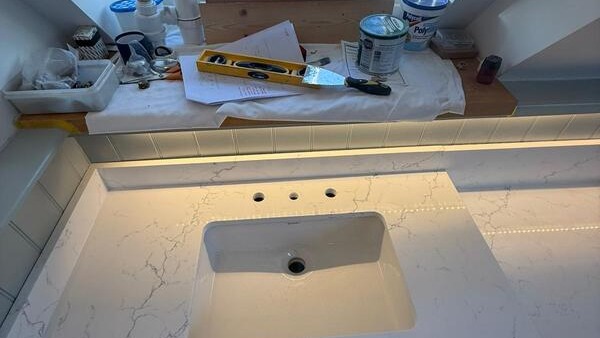
- Sink, hob and tap cutouts cut to the exact template of the appliance you're fitting, not a generic size
- Mitred joints for L-shaped and U-shaped runs, with grain or pattern matched across the joint before it's cut
- Edge finishing, including routed edge profiles, resealed post-formed edges, or a polished edge on stone and quartz
- Sealing every cut edge against water ingress before the worktop goes anywhere near a sink or hob
- Removal and disposal of the old worktop and offcuts under our registered waste carrier licence
Not Included / Costed Separately
- Cutting a worktop bought elsewhere without us seeing the actual board first - material, thickness and batch condition all affect whether we can guarantee the cut
- Structural alterations to cabinets or carcasses needed to fit a non-standard cut - quoted as a separate item once we've seen what's involved on site
- Full slab stone cutting attempted on site - granite and marble slabs go to the workshop for diamond-blade cutting and polishing, that's not a job for a kitchen floor
- Ongoing resealing of cut edges around a sink after the first year - worktop sealant does wear with use and is worth checking annually yourself
How A Worktop Cutting Job Runs From First Call To Fitted
- Tell us what you're working with: Call or message with the worktop material and a rough idea of the kitchen. Laminate swaps can often go straight to booking a cutting slot, while granite, marble, quartz or sintered surfaces need a template visit first.
- Free home visit and laser template: For anything beyond a straightforward laminate replacement, we come out and laser template the actual space, checking wall lines at several points rather than just one, since older Nottingham properties are rarely as square as they look, plus appliance positions and your specific sink or hob model.
- Cutting: Laminate and solid wood are usually cut with a TCT-tipped blade, either on site or at the workshop, within days of the template. Granite, marble, quartz and sintered surfaces go to the workshop for diamond-blade wet cutting and polishing, work that needs proper extraction and equipment a domestic jigsaw can't match.
- Fitting: Mitred joints are dry-fitted, adjusted and then bonded and clamped, sink and hob cutouts are test-fitted against the actual appliance before it goes in, and every cut edge is sealed before the worktop is screwed down or bonded to the carcass.
- Sign-off: We walk the finished worktop through with you, check joins, cutouts and edges together, and issue the written installation warranty - five years on labour and installation, two years on the worktop product itself.
What Cutting And Fitting A Worktop Actually Costs
Independent UK cost data - MyJobQuote's 2026 laminate worktop cost guide - puts labour for cutting and fitting a laminate worktop, including on-site cutting, at roughly £250 to £600 for a small kitchen, with a full laminate worktop installation typically landing between £200 and £600 depending on run length, how many joints there are, and how many cutouts need to be cut. Those figures are for laminate. Stone, quartz and sintered surfaces cost more to cut because they need diamond-tipped blades, water-fed equipment or workshop machinery rather than a jigsaw, and because the templating has to be right first time - a granite worktop cut a few millimetres wrong can't be sanded back the way laminate sometimes can. We won't put a firm figure on your job without seeing the kitchen.
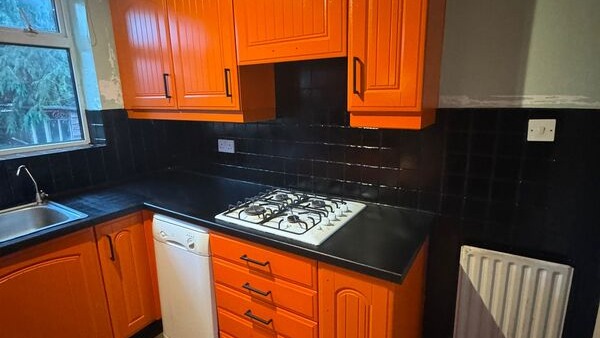
Wall lines that look straight rarely are, especially in older Nottingham terraces, and that affects how much material is needed and how much risk there is in the cut. A free home visit gets you a written, no-obligation quotation with the cutting, fitting and sealing all itemised, so nothing gets added on once the job's under way. If you're planning a full kitchen replacement rather than just a worktop swap, that's a separate conversation - complete kitchens through us start from around £5,000, with finance available through an FCA-regulated partner, subject to status.
Cutting It Yourself, Cut-Only, Or Full Fit - What Actually Suits Your Job
| Cutting it yourself | Our template-and-cut service | Full design, supply and fit | |
|---|---|---|---|
| Best for | Straight laminate cuts, confident with tools, working to a tight budget | You've already bought or chosen the worktop and want a professional cut and fit without a full kitchen project | A new kitchen or replacing multiple runs, project-managed from first call to handover |
| Equipment needed | TCT jigsaw or circular saw blade for laminate - not suitable for stone or quartz | Laser template plus in-house TCT and diamond-blade cutting, laminate through to quartz and sintered surfaces | Same cutting capability, plus coordination of joiners, plumbers, electricians and gas engineers |
| If it goes wrong | You cover the cost of a replacement board and any lost time yourself | Covered by our written installation warranty | Covered by our five-year labour and two-year product guarantee |
| Typical turnaround | A weekend, if the first cut goes to plan | Template visit, then cutting and fitting within days for laminate, longer for stone | Scheduled as part of the wider project timeline |
Why Homeowners Let Us Make The Cut
Cutting a worktop badly is one of the more expensive DIY mistakes in a kitchen - a mismeasured sink cutout or a cut that's a few degrees off square usually means buying another board rather than sanding the problem away. We've been cutting and fitting worktops across Nottingham and the wider East Midlands for over 20 years, as a family-run business rather than a franchise, and we've handled the worktop on well over 800 kitchens, from tight Victorian terraces in the Lace Market where no wall in the room is actually straight, to newer city-centre apartments where the challenge is squeezing a run around services boxed into the wall.
Cabinetry and cutting work is carried out by City & Guilds trained cabinet makers, and where a job moves into granite, marble, quartz or a sintered surface like Dekton or Corian, that's jointed by stonemasons rather than a general fitter with a diamond blade borrowed for the day. If your worktop cut needs a hob cutout, the hob itself is commissioned by a Gas Safe registered engineer rather than left for you to connect afterwards, and any plumbing around a new sink cutout is handled by NVQ Level 2 and City & Guilds qualified plumbers. Every job, cut-only or full kitchen, gets a written agreement before work starts and a formal sign-off with an installation warranty at the end, so there's a record of what was agreed and what was actually done, with no extras added part way through. We're members of the Construction Industry Training Board and the Federation of Small Businesses, and because it's the same small team from quote to completion, you're talking to the person who'll actually be making the cut, not a call centre reading a script.
Where We Cut And Fit Worktops
Nottingham is home base - the workshop's a short run from the city centre, so a laminate worktop cut for a kitchen in West Bridgford or Wollaton is normally in and fitted within days rather than weeks. Templating gets more careful, not less, in the Lace Market and around Nottingham Castle, where solid stone construction and the old sandstone caves underneath mean floors and wall lines are rarely square - a laser template catches that before the saw does, rather than after. Out toward Beeston, Arnold and Sneinton it's usually a straightforward like-for-like laminate or quartz swap, and Stapleford and Long Eaton sit close enough that stone worktops cut in the workshop can go out for fitting the same week.
Further into Nottinghamshire we cover Mansfield and Kirkby-in-Ashfield, and into Derbyshire we cover Derby, Alfreton and Heanor, with the working radius stretching toward Chesterfield and the Derbyshire border for bigger stone and quartz projects. We also travel to Sheffield, Wakefield and York for larger worktop and full kitchen installs - for those it's worth flagging the distance when you call, since travel time factors into scheduling the template visit and the cutting itself.
Got Questions?
Frequently Asked Questions
What tools do I need to cut a kitchen worktop myself?
For laminate, you want a circular saw or jigsaw fitted with a fine-tooth TCT (tungsten carbide-tipped) blade - not a diamond blade, that's for stone - plus a straightedge or guide rail, clamps, a sharp utility knife to score the laminate face before cutting, masking tape either side of the line to reduce splintering, and sandpaper or a file for the edge afterwards. Eye protection and a dust mask matter more than people expect, laminate dust gets everywhere and isn't pleasant to breathe. For anything solid - granite, quartz, marble or a sintered surface - you're into diamond-blade wet cutting or track-saw equipment most households don't own, and that's genuinely a workshop job rather than a driveway one.
How do you cut a worktop around a sink cutout?
The cutout is taken from a template of your actual sink, not a generic size off a packet, because tolerances between sink models vary more than people expect. The line is cut with a jigsaw or router following that template, with the corners radiused rather than left sharp - sharp internal corners are where stress cracks start under the weight of a full sink and drying rack. The edge is sealed immediately, and the cutout is test-fitted against the real sink before anything is caulked in place, so if it's a whisker tight there's still a chance to adjust it.
How do you keep laminate worktops from chipping when you cut them?
Score the top laminate layer with a sharp utility knife along the cut line before you touch it with a saw - that single step prevents most of the chipping people get frustrated by. Use a fine-tooth TCT blade rather than a standard wood blade, keep the blade height just proud of the material thickness rather than set deep, and run masking tape either side of the line to support the surface as the blade exits. Which face goes up depends on the saw: with a circular saw the decorative face goes down, with a jigsaw it goes up. Get that the wrong way round and you'll chip the visible edge no matter how sharp the blade is.
Can worktops be cut on site or do they need to go to a workshop?
It depends on the material. Laminate and solid wood are routinely cut on site or in the van outside your kitchen using a track saw, which is quick and means less disruption. Granite, marble, quartz and sintered surfaces like Dekton go to the workshop, where diamond-blade wet cutting and polishing equipment can handle the weight and dust safely - that's not something we'd attempt in someone's kitchen with the water supply and extraction a stone slab needs.
Do you need special blades to cut quartz worktops?
Yes - quartz and other engineered stone need diamond-tipped blades, and cutting is normally done wet, with water fed to the blade, because dry-cutting engineered stone throws up crystalline silica dust, which is a recognised health hazard in the trade and one of the reasons this work goes to the workshop rather than a kitchen floor. A standard wood or laminate blade will simply burn out or shatter trying to cut quartz, it isn't a case of pressing harder.
How do you cut a mitred joint for an L-shaped worktop so the pattern lines up?
Both ends of the joint are cut at 45 degrees and dry-fitted before anything is bonded, so grain direction on solid wood or pattern flow on laminate and stone can be checked and adjusted while there's still room to correct it. On stone and quartz the joint is pulled together with joint bolts or biscuits and a colour-matched resin, then clamped until it's set and polished flush; on laminate a router jig keeps the mitre angle consistent across both boards. Pattern matching is genuinely easier on some materials than others - a busy granite pattern hides a joint better than a plain, pale laminate does, which is worth knowing before you choose the finish.
What's the correct way to seal a cut edge on a laminate worktop to stop water getting in?
Worktop sealant needs to go onto the raw chipboard core straight after cutting, before the board is fitted, not after - water that gets into an unsealed edge swells the chipboard and there's no fixing that once it's happened. Where the cut meets a wall or a sink, an upstand or edging strip gives a second line of defence on top of the sealant. It's worth checking the seal around the sink and hob areas roughly once a year, since it's the section that sees the most water and wear, and topping it up costs a lot less than replacing a swollen board.
I've already bought a worktop online - will you come out just to template and cut it to fit my kitchen?
Usually, yes, but we'll want to see the board first, or at least get the exact material, thickness and batch details from you, because worktop bought elsewhere varies more in flatness and finish than people expect, and we can't guarantee a cut on a board that's warped or an odd thickness for its category. Assuming it checks out, we template your kitchen and cut it to fit, the same way we would with a worktop we'd supplied ourselves.
What's the most common mistake DIYers make when cutting their own worktop - the kind that ends up costing more to fix?
Two things come up again and again. First, cutting the sink hole from a generic template printed on the sink box rather than measuring the actual sink - tolerances are tighter than people assume, and a hole cut even slightly wrong either leaves a gap or won't fit at all. Second, not sealing the cut edge straight away - leaving it overnight or longer lets moisture into the chipboard core before the sealant goes on, and by the time it's noticed the edge has already started to swell. Both are avoidable with the right order of operations, and neither is cheap to put right once it's happened.
Laser templating means • In-House Team • Guaranteed Work
Quick Free Estimate - No Obligation
Fully Insured • Response within 15 mins
🔒 Your details are safe with us. No spam, ever.